Mother’s Day to Teach Charity, Mercy, Patience

Julia Ward Howe, known for writing the lyric to ‘The Battle Hymn of the Republic” was deeply disturbed by the carnage of the Civil War.  She created a ‘Mother’s Day Proclamation’ in 1870 and wrote a poem about Mother’s not tolerating others leading their sons away from goodness.  Here is part of what she penned:

Arise, then, women of this day!
Arise all women who have hearts,
Whether your baptism be that of water or of tears
Say firmly:
 
“We will not have great questions decided by irrelevant agencies,
Our husbands shall not come to us reeking of carnage,
For caresses and applause.
Our sons shall not be taken from us to unlearn
All that we have been able to teach them of 
charity, mercy and patience.

1870 Mother Holding BabyShe must have believed that a nation is only as great as it’s women.   She created a “Mother’s Friendship Day” to honor peace .  It’s purpose was to reunite families and neighbors that were divided by the Civil War.  The holiday was observed in several U.S. cities until Howe stopped funding it.

In 1908, Anna Reeves Jarvis created “Mother’s Day” and her daughter Anna M. followed it through to a U.S. official holiday in 1914.  They too, wanted to honor motherhood and it’s powerful influence for good.  The unexpected commercialization of the holiday left daughter Anna trying to “undo” the holiday the rest of her life.

A few kindred women that were mothers before “Mother’s Day” became official were:  Martha STEPHENS 1872-1914, Elizabeth FITZGERALD 1870-1912, Mary COCHRAN 1853-1925 and Odella HARKNESS 1873-1944.  Look for a new post about Odella soon.

1+1+1 = The Truth

After reading an article by Kevin Cool, a mathematical equation of sorts seemed to evolve when writing about families.  It boils down to:   1 + 1 + 1 = Truth .  Another way to write it is:  a+b+c = A More Realistic Picture of the Past.  

Kevin Cool, the editor Of Stanford Aumni Magazine tells of his adventure in writing the truth about his dad and grandfather in the May/June issue.  His equation adds up as follows:

Currier and Ives Print of Farm and Fielda) ‘. . . a soft-focus version ‘ that casts his dad and grandfather living on a small farmstead with a meandering stream surrounded by pretty meadows with nearby forest full of woodland creatures. Sort of like a Currier and Ives painting.

Interior of a small cabinb) the ‘ grittier version’ of the small 2 room house with no indoor plumbing, water or electricity with grueling winters. Kevin states that both of the descriptions are accurate BUT neither of them is really true.  It was only after an interview with his father that he ‘grasped the complicated reality of his childhood. . . It was a hard life.  And it was a happy life.”

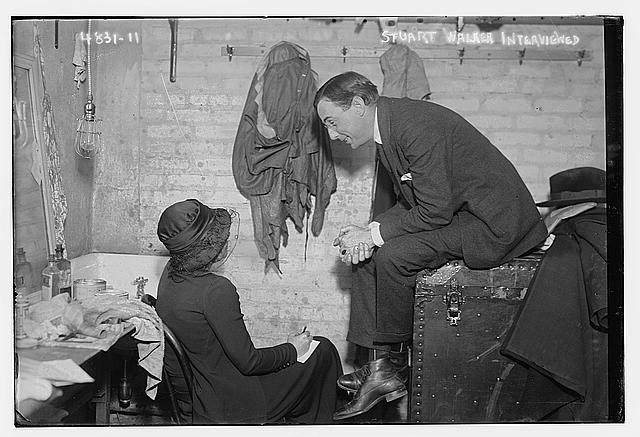
Old Photo of a Kindred Interviewc) “To reveal how people lived . . . you need more than accumulated facts.  You need Continue reading

The BARKER Family

1930 Census of the BARKER Family in Augusta GA

1930 Census of Starne Street, Augusta GA

Home of William and Essie BARKER on Starnes Street in Augusta GA

2018 Starnes Street in Augusta GA as it stands today

Residing on Starnes Street in Augusta, Richmond County, GA in 1930 was the BARKER Family. They are found in the 1930 U.S. Census records.  Census records are interesting reading; mostly fact interspersed with tidbits of fiction.

The head of the household was William W. (Washington) BARKER at age 32.  ‘M’ stands for male and the number ’19’ on his line of information tells his age when he married.  He worked as a ‘Car Inspector’ for the Railroad.

Essie E. (‘E’ is really Lee) BARKER is William’s wife, age 35 and married at age 22 according to the record but she was actually 25 years old when she married . . . but who’s counting?

Daughter Evelyn BARKER is 8 years old in this census.

William and Essie lived at the Starnes Street house until about 1960 and Evelyn lived there for her entire childhood.

William and Essie BARKER on Starnes Street

William and Essie BARKER abt 1959 standing in front of the Starnes Street Home

Image

Just a Match Book, or More?

It’s just a matchbook cover but when I spotted it in a tin full of assorted matchbooks at a garage sale, it stood up and shouted to me “HERE I AM !!!!!!!”

 This is a matchbook that Charles HOPKINS‘ place of employment, “The Independent Life & Accident Insurance Company” used for years.  They must have made a few gazillion of them with half of that gazillion in our house.

It’s amazing how strong memories develop from childhood.  Smells and visual icons are like time machines for me, traversing years in mere seconds.

I’d never seen the Statue of Liberty but that was no reason for me not to know who she was.  Everyone knows her.  And even though the company was headquartered in Jacksonville Florida instead of New York, that was no reason not to use her as the main icon for the company.

Paper matchbook with scalloped edges, yellow with gold and black Statue of Liberty in center with gold surround of Independent Life Insurance Company.

The Last Two Letters of James DICKERSON

This slideshow requires JavaScript.

Understanding and forgiveness appear in Letter 11.  The realities of war are described and as ever, James has a keen sensitivity to crops and prices of goods in the area.   He still has no money and is concerned about his family having shoes.

The last letter, number 12 is penned by someone other than James due to his injury.  He is in a Confederate Hospital in Richmond, VA.

Letter 11

Virginia  richmond      June the 20th

Dier wife      I take the plesier of droping you a few lines to informe you that I am well at this time and I hope this will find you all well      I reseved youre leter dated the 11 witch please me vary mutch to her that you was all well and you have become reconsiled about your spyses       I a sorra to think you had that opinion of mee       Wright pritchet died last night and his brother cant carry him home       it cost $40-$50 dolers to barry ethring so ther is no chance for the pore       I int to git my tipe to you for there is no chances        there is one hundred men in this company and about thirty four duty tha ar qurd of them that —- it gives them the brake         tha ar fiting every day in  – ———the ole gineral burnt everything up the tents and everything        we have only what we had on our backs        tell my farther [father] [1] that tome [Tommy] [2] is her and looks as well as I ever seen him       his ridgment is in our brigade       Corne is three dolars a bushel her      sirup is five dolars a galon       are you making aney corne       I reseved youre leter that tha ole mail in one day the 17       Yall rote to mee wether I got pleanty to eat or not       I doo sutch as it is       Bread and meat       wheat bread at that         wee git som beef ons a week       I have got a bunch of wheet      Crops is vary good her       you don’t no how glad I would be to see you all       I doo dreame about you aften times        I think if I doo ever git out of this I will stay at home the balans of my dayes     I don’t hav eny idea that tha war will last mutch longer Continue reading

What Else Happened in 1862?

1862

James DICKERSON’s letters to his wife Clary were written in the year 1862.  Of interest are other events that happened the same year:

  • The first income tax was implemented;  3% of incomes less than $600.
  • Paper money called ‘greenbacks’ were issued to the United States by President Abraham Lincoln.
  • The United States Mint was established by Congress in Denver CO.
  • Bucharest was proclaimed the capitol of Romania.
  • Julia Howe published “Battle Hymn of the Republic”.
  • The U.S. Navy’s first ironclad ship was launched and in the same year their ironclad ship ‘Monitor’ sank off Cape Hatteras, N.C.
  • Congress outlaws polygamy.
  • Emancipation Proclamation was issued by Abraham Lincoln, freeing slaves in the U.S.
  • The Battle of Antietam was fought and was the single most deadly day of the Civil War with 23,110 casualties.
  • 1st pasteuriztion test completed by Louis Pasteur and Claude Bernard.
  • The bowling ball was invented.

Unhappy and Upset – Letters 9 and 10 of James DICKERSON

Civil War Balloon 'Intrepid'

In Letter 9, James wants information from Clary to change his situation in the military stating that he ‘can’t live this life’.  His possesions include a blanket, napsack and discarded knife.

In Letter 10 the strain of separation from his wife is manifest.  It would be so interesting to know what Clary said in her letter dated June 4th.  We can only imagine  it expressed displeasure and some distrust after Letter 5 where James wrote about the women he had seen and his desire to go fishing with Clary.  James ends letter 10 rather cold and business like.

The National Park Service website astutely describes the average soldier of the civil war;  ‘They would face diseases they had never known and wounds they had never imagined. And through it all, these common-folk-turned-soldiers would endure homesickness to a degree none of them had ever envisioned.’

Letter 9

Richmond Virginia    June the 10 1862

Dier wife      I take the plesier of droping you a few lines to informe you that I am well at this time and I hope this will find you injoing the blesing      I want you to rite to mee as soon as you git this leter      I want you to rite to mee what ridment Wiley [1] is in Va and all about it for I don’t aime to sta her      I can get a transfer to my brother anewher you can fine out from J. Grant [2] and from Any Brown [3] the life I live      I cant live this life      I have got one blanket and my napsack and the knife that lutie give to Brown the time of the retreat he throde it away and I pick it up and I am a going to fetch it home if I cane      Nothing more at present only I remane youre husban until death

by D.J. Proctor to Mrs. C. Dickerson

J.H. DICKERSON

[1] Wiley is James’ younger brother born 8 Oct 1835.  He enlisted in the 32nd Confederate Infantry Regiment, Company H.

[2] J. Grant is probably J.L. Grant found living in Proctor, Monroe County, GA at the time of the 1860 census.  He was born about 1825, was married and had 5 children.

[3] Any Brown is most likely Andrew J. Brown who enlisted in Company H of the 32nd GA Infantry Regiment on 6 May 1862 just as Wiley DICKERSON.

Letter 10

Virginia Richmond    June the 14 1862

Dier wife      I seat my self to informe you that I am well at this time      I reseved yore leter dated the 4 witch I was sorry to her that you was displeise with the one I sent you [1]     I ment no harme of it      you did not understand it about not being at home when you rote      I had no blank look nor the old man and wher did you git it and william Brown [2] told me that he heard your brother Henry say  that he was going to move you closer to his hous and I rote to you I would be glad to be at home so mee and you could go afishing witch was no harme      I have no spise ther [spies there] and I dont want you to rite to mee about none of youre Dam spise and if cant [d]o so I dont want you to rite at all you can use youre one plesier about it      I think that the war will come to a close      I am as hapy as if were soner      I see yankes every Day tha have berloones [3]      you dont rite whether you ar making any corne or not       So good evening      Nothing more at presant

J. H. DICKERSON

[1] Letter 5 dated May 24

[2] William Brown was from Monroe County GA and enlisted in Jame’s regiment on th 4 Mar 1862

[3] Union army balloons were a common site in the Richmond area.  The ‘Gazelle’ and ‘Intrepid’ were two balloons used at this time.

From ‘Seven Days War Ballooning in the Civil War’ by James Green we learn:

” . . nearly daily balloon ascensions at Yorktown attracted much attention from the Confederates with the balloon being a constant target for their guns. Lowe stated, “the enemy opened upon it with their heavy siege guns or rifled field pieces, until it had attained an altitude to be out of reach, and repeated this fire when the balloon descended, until it was concealed by the woods.”

150th Anniversary of the Civil War

We are in the 150th anniversary of the Civil War 1861-1865.  There are many events commemorating this piece of history coming up in the next year or two. Many of our kindred dead were involved in this war.  It’s a great opportunity to enrich your lives while the anniversary is being observed.

You might find something of interest by looking at the Civil War Sesquincentennial Events site.  Just enter a state to see if anything is happening where you’re at.

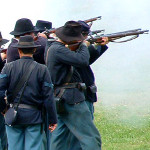
Civil War Reenactment at Kennesaw Mountain National Park

For instance, this summer on July 28th there is an Artillery Demonstration at Kennesaw Mountain National Park, just northwest of Atlanta.

The Kennesaw Mountain Website posts tidbits of facts named “Did You Know”.  An example of one is below.

Did You Know –  Confederate armies were usually named for states or regions where they campaigned, while union armies were named after major rivers.  Thus the Confederate Army of Tennessee opposed to the Union Army of the Tennessee.

An 1862 Easter

Happy Easter.  Thoughts and hopes of restoration are hard to resist when learning about our kindred ancestors who’ve moved on, especially the many who suffered and died in war.  I found an Easter sermon written in 1862 at Civilwar.com that sheds light on concerns and challenges of the day.

In addition, I’ve included a couple of videos about Aimee Copeland, a young woman who recently suffered the challenges of amputation.  She is an inspiration as are many others in our own family.

The sermon does not lack for words, thought or content.  Death is likened to sleep.  Just as the body requires sleep and rest for restoration, so does the soul require death to be restored, calling it “tired nature’s sweet restorer . . . ”
screenshot12

“Now, such is the effect of the body’s visit to its grave . . .  all weary and worn . . . They go there with the furrowed brow, the hollowed cheek, the wrinkled skin—they shall wake up in beauty and glory. The old man totters there, leaning on his staff. The palsied comes there, trembling all the way. The halt, the lame, the withered, the blind journey in doleful pilgrimage to the common dormitory. But they shall not rise decrepit, deformed, or diseased, but strong, vigorous, active, glorious, immortal!

Out of the 3 million men who fought in the Civil War on both sides, most of them had a rural, agrarian background like James DICKERSON.  They had a keen understanding of the growing seasons and the importance of seeds with their renewal or germinating power.

“The shriveled seed, so destitute of form and comeliness, shall rise from the dust a beauteous flower. A green blade all fresh and young shall spring up where before there was the dried decayed grain . . . “

The casualties of war included not only loss of life, but amputations and disfigurement as well.   The reference to ‘the holy martyrs’ who suffered similar trials gives way to hope of restoration.  Back then in 1862, most relied on faith in God to make sense of death.  But today we have . . . uh, well. . . let’s see . . . about the same thing.

“Well said the holy martyrs, when their limbs were being torn away—’We cheerfully resign these members to the God who gave them to us.’ Our members are not ours to hold or lose, no torment can rob us of them in reality. For when we wake up in Christ’s likeness it will not be as halt or lame, but full of strength and vigor—more comely than earthly sons of men . . . The winter of the grave shall soon give way to the spring of resurrection and the summer of glory. Blessed is death, since it answers all the ends of medicine to this mortal frame and through the Divine power disrobes us of the leprous rags of flesh, to clothe us with the wedding garment of incorruption!”

A modern story of inspiration and bravery in the face of bodily trials is found in Aimee Copeland, a young University of GA student who suffered a gash to her leg from a river rock when she fell from a faulty home made zip line.  An infection in her leg gave way to a flesh eating necrosis that led to amputations and organ failure.  Not only did she beat the odds and survive but Continue reading